Thursday, September 29, 2011

The Rainbow Sandals Gerry Lopez Battle of the Paddle

2011
Doheny State Beach, Dana Point, CA

SUP with Diabetes is an inspirational blog where I share my stories and adventures with Type1 diabetes and Stand up Paddle boarding (SUP). I am trying to beat the odds and turn my diagnosis and passion for SUP racing and surfing into a platform.  As a Type1 diabetic, an Elite and top age group SUP racer I am hoping to inspire and motivate others facing obstacles in their own lives, and too help the world understand diabetes.
This past weekend I competed as an Elite paddler and an age-grouper in what the SUP community considers the premier SUP racing event of the year, the 2011 Rainbow Sandals Jerry Lopez California Battle of the Paddle.

The fourth annual Battle of the Paddle in Dana Point, CA, held on Sept. 24-25, brought out the best Stand Up Paddlers in the world. The extremely competitive races drew approximately 1,000 competitors, who chased the $25,000 prize purse, as well as thousands of local spectators. The weekend’s events were broken into multiple divisions and race types, including elite, long distance, age group races and SUP surf relays.
Thousands of spectators gathered along the shore to watch the Battle of the Paddle.

From North to South the beach was packed!

My first race was the Elite race - heat 1, with only the top half of the 80 or so racers advancing to the Elite finals.
I knew I could paddle the distance without any problem, it’s the speed and intensity of the race that I had to pay attention to. My blood glucose level was about 180, thirty minutes before the start so just about five minutes from the star I drank a bottle of Hint Water combined with a carbohydrate supplement, "good to go".
I got caught up in traffic and never recovered, stayed pretty much in the middle of the pack the whole time.

After a couple of super crazy buoy turns and some massive carnage in the waves and on the beach, I was paddling hard and determined to leave it all on the water.

My blood sugars  would not be an issue due to the short distance short distance . But they could become a factor due to the extra excitement, adrenaline, chaos and the flat out speed of Battle of the Paddle.

The crazy board to beach transition, boards flying, thousands of people screaming, some of the most fun I've had in a while. At this very moment I'm living!
In the end I finished in the middle of the pack and would not advance to the Elite finals.
I grabbed my board and began to prepare for the Open Age group race. My blood glucose was at about 150, I needed to eat so I had a snack and took around 3 – units. With 2 hours until the start I knew I would peak just before. So just prior to the race I tested and was around 120. So I drank another bottle of Hint Water and carbohydrate supplement and ate a Cliff bar.
The start of the Open Age Group race.
I'm feeling great and had a great start.
The bouy turns in the Open race were wild, alot of different paddlers to deal with.
No waves on the way in.

Just about to the beach and the finish.

Jay "Sparky" Longley, Paul Zacharias and Jerry Lopez
2nd Place in the Open Age-Group Race SUP Stk. 40-49 Mens division.
FullResults:

Age Group SUP Individual Results - Stock M40-49

Erik Nordskog of OnIt Pro after my race. Thanks to Erik and OnIt Pro for hooking my board up with Xtreme Cream And Blue goo, its working great I feel like I am flying through the water.

The start of the Elite race.
Just over 80 paddlers who advanced from the earlier heats line up for the start of the
2011 Battle of the Paddle
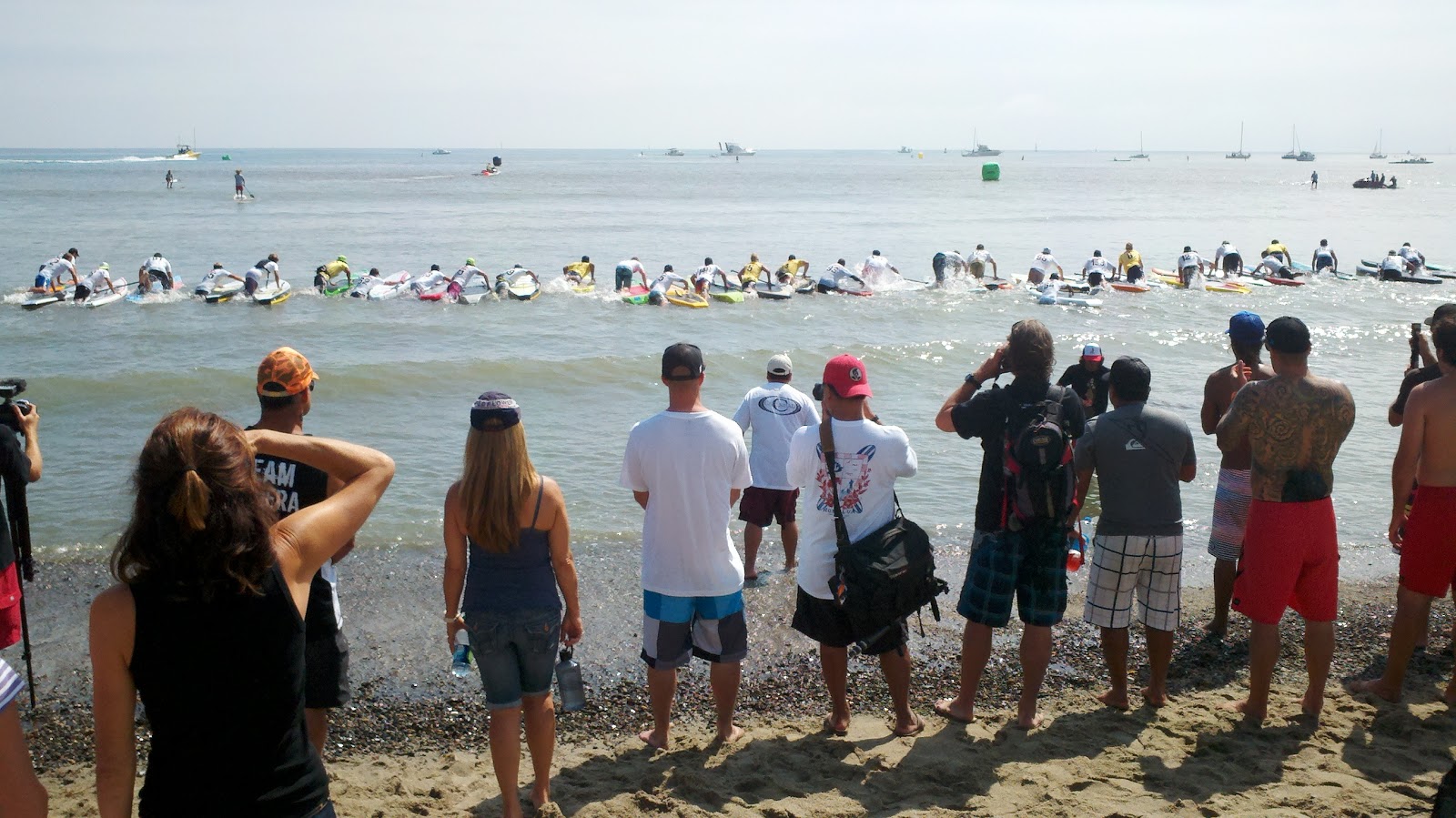
The start of the race.
This is about thirty seconds after the start. These guys are flying.

This is a great shot from the water at the start.
The carnage and mahem that took place at a few of the bouy turns was off the charts!

Here a wave breaks just as the middle pack is coming around the bouy.
Boards crashing and people flying into the water, this is racing!
Chain reaction!
 Racers and boards handelers.
The run up the sand and through the flagged area.
At the finish Conner Baxter, Jamie Mitchell and Danny Ching.
The Elite awards cerimony.
Elite Race Results:

Jerry Bess, Fernando Stalla and Giordano Capparella.
Jerry Lopez
Paul Zacharias and Jamie Mitchell rockin' the Kaenon Sunglasses.
Jimmy Terrell and Paul Zacharias
The girls of "Lazy Dogs", from Key West.
Hanging with Sandy of the "Lazy Dogs'.
Start of the Distance race on Sunday.
Water start and their off!
10 Miles of fun!
Danny Ching 1st Unlimited
Dave Bohene, Chance Feilder and Slater Trout un-official 2nd place. These guys were playing around on a new board designed for three paddlers, they were named most inspirational.
Results:
Perfect way to end the day....
I met so many interesting people and had the time of my life. I learned a lot during my first attempt at the battle of the Paddle and will try to capitalize on the lessons so that next year I will do better.
Thanks to God, all my sponsors and friends and to Rainbow Sandals and Jerry Lopez for an amazing weekend of Stand Up Paddle racing.

Aloha


Tuesday, September 20, 2011

2011 Hennessy's World SUP and Paddleboard Championships

Hermosa Beach, California - Saturday, September 17, 2011
Over 150 of the world’s best paddlers arrived in Hermosa Beach this past weekend to compete in the World SUP and Paddleboard Championships, the event attracted thousands of spectators who packed the Hermosa Beach pier. And amazingly enough I was one of those paddlers. I had qualified earlier in the year at one of the World Paddle Association sanctioned races; actually it was during the U.S. Championships this past summer.

It was overcast and a little windy with somewhat choppy seas by the time the race started and there was just enough surf to keep it interesting.


Lots of folks from the SUP industry were there.

Lots of spectators.

It was to be a 7 mile course with a beach start and a beach finish; it actually turned out to be just shy at 6.8 miles.

Races are won and lost at the start.

When you race as with most things in life, you try and get off to a good start. If you don’t, you will basically be playing catch-up the entire time. In paddling a bad start can cost you seconds which can easily turn into minutes.

As the start of the race approaches you need to keep all of your focus on what your about to do and stick with your plan. Your goal is to get up on your board and moving at full speed as soon as possible. If you hesitate or fail to do this the other competitors that paddle at the same speed as you will create a gap that you more than likely will not be able to make up.

This was the case with my start at the race on Saturday. I floundered at the start and it cost me a couple of spots at the finish. Oh well, there’s always next time.

Other than a poor start and maybe my less than stellar finish in the surf, I had a really good race and felt strong throughout. My blood sugars were perfect and so I really can’t complain.


I feel absolutely blessed to have competed in a race with a group of the world’s top ranked Stand Up Paddlers.

I thought that I might be able to be some what competetive in this sport when I started back in January of this year, but I had no idea that I would be competing in the world championships. Like I’ve said before, “I guess God has a plan”.

Here is the link to the results.
http://worldpaddleassociation.com/wp-content/uploads/2011/09/Hennesseys-World-Champ-results-2.pdf

I finished 27thoverall in the SUP Stk. Class and 7th in my age group.

Preparation is key is the key to success; I have put in a lot of time on the water in the last 9 months or so but feel that I failed to maximize my potential as an athlete. There are a number of things that I need to do in the upcoming months leading into next year’s racing season.
One key component to my continued success would be to design an individualized program, with specific attention in regards to my diet and of course to set goals related to performance and habits.
Goal setting would be critical to my future success, as would be continuing to work towards them. Setting goals can provide motivation, direction and assist in progressing forward.


Having someone to assist me and to help me with devising the best plan for training would be key to improving. With someone else helping with my training it’s more likely that I will work on specific weaknesses and my overall performance. The structure of an individualized training program will also decrease my risk for injury.
Getting out on the water immediately after a race and working on the areas in which I failed or struggled with during the competition.
Learning from my mistakes and practicing to let them go and to move on, focusing on the things that I did successfully in order to maintain an elite level of performance.
Continued pursuit of mental focus, increasing the time I spend on training my mind, visualizing my success prior to my competitions.
These are some of the things that will help me to become a better Stand Up Paddle racer and would help anyone pursuing any number of things in their lives in which they to desire to do.

Sunset in Hermosa Beach, Aloha!

Thanks again to all my sponsors!

Tuesday, September 13, 2011

Paddle2Live - Paddling together to bring courage, strength and grit to the fight against cancer


Just two years after his cancer treatment, Jack Marshall Shimko, an avid waterman and outdoor enthusiast is ready to embark on his 2nd annual mission to beat cancer through his favorite sport.

 In late August of 2011, Jack will begin his 260-mile ultra-marathon paddle in the open ocean as a Team Duke Athlete to fundraise for the John Wayne Cancer Foundation. Jack will depart from Pt. Conception, CA, and plans to paddle 26 miles a day for 10 days, touching all 8 of the Channel Islands before reaching his hometown of Newport Beach.


This past weekend I had the opportunity to take part in the 10 mile Elite Stand Up Paddle race to help raise money for the John Wayne Cancer Foundation and to support Jack Marshall Shimko in their goal of raising $1,000,000 towards their fight against cancer.

The view from my truck on the way to the race.

I was up early drank my water, ate my oatmeal, grabbed a cup of coffee, injected 4 units of insulin and was on the road by 6:00 A.M., heading north from San Diego to Newport Beach. I had just reached Dana Point when out of nowhere this unexpected storm, with rain, hail, lightning and thunder burst from the sky!

I had been visualizing and thinking about the race, listening to some Van Halen on the car stereo.  
My plan was to get off to a quick start, paddle hard and fast for the first 2 miles, get to the buoy with the lead pack, once there I could make the turn south and set my pace for the next 4 or 5 miles ensuring a good position at the second buoy turn placed just at the end of the jetty there at the Wedge.

This is when I would begin to hydrate with my Hint Water and mixture of carbohydrate dietary supplement (rapid energy fuel made from natural juices). This strategy would ensure that I keep my glucose levels up, avoiding any unwanted lows.

It was a great plan; I had trained and was feeling good and was ready to go. Then Mother Nature stepped in and decided to throw a little curve ball at me.


This is what it looked like at the beach early before the race, there was rain, thunder, and lightning and of course wind. No excuses though, I am a waterman and need to be prepared for all types of conditions. But I have to admit, it does take a lot more effort to paddle when it’s like victory at sea and there is no consistent swell direction and you’re basically paddling in a washing machine for 10 miles.

No worries, I checked my blood sugar, ate a banana and got some stretching in and got ready to race.


Suzy Strazzulla and I checking out the conditions and talking about the upcoming race.


Some of the racers in the 10 mile Elite class gather around for a pre-race meeting.


This is Mandy McDonnell from the John Wayne Cancer Foundation with the course map.

Here I am with Mark Pighini just prior to the start.

Looking out past the Newport Beach pier towards the horizon the sky is dark and not looking to friendly, I think about Jack Marshall Shimko who is somewhere out there finishing the final leg of his 260 mile paddle down the coast of California and start to realize that this little 10 mile paddle is nothing compared to his battle.

Jack had been diagnosed with Hodgkin’s Lymphoma and only 2 years after his treatment he was enduring all that a 10 day 260 mile paddle down the coast of California could throw at you.

I have the utmost respect for people like Jack Marshall Shimko. As a matter of fact I have a list of people just like him that have been forced to deal with an unwanted disease or disability and have chosen to stand up and face it head on in an attempt to make a difference.

I’m not trying to compare diabetes to cancer, but as I looked out at the ocean I realize that there is a similarity between what Jack is doing and what I am doing.
We each have something that we want to achieve, something we are aiming for – a goal. We both are people who are giving rise to an action, or a condition – a cause.
I tested my blood sugars one last time and was a little high, somewhere around 250. So I injected 2+ units of insulin thinking that I would be able to manage and level out when I began to replenish with my water / carb mixture.
The start of the 2011 Paddle2Live 10 mile Elite race.
The horn blows indicating the start of the race and I am running through the surf and up on my board as fast as I can.  I reach, set, catch and pull my way through the chop, heading out to the first buoy 2 miles off shore. I try and focus on technique and my plan, knowing that my battle with the oncoming swells and the erratic conditions will test my skills and push my body to its limit for the next 2 hours or so.
I reach the first buoy make the turn and start my paddle south. I fall off my board after being hit by a swell that seems to come from out of nowhere. I get back onto my board as fast as I can and continue to paddle south through the bump and the chop.
I’m forced to paddle on one side for what seems like forever, my left arm is taking a beating. But as I look into the distance I can see other paddlers and they too are fighting the swells and enduring the same conditions.
As I struggle with the conditions, getting mad at myself for not training harder and for not being stronger. I think about Jack, I think about our goals, our cause’s and all those that we are trying to inspire. This gives me the motivation I need and I continue to paddle as hard as I can.
During the 10 mile Elite race Jack completed his paddle from Point Conception to Newport Beach, arriving just north of the Newport Beach Pier. You can see the Virgin Oceanic’s racing catamaran, the 125′ Cheyenne, this was the support boat that accompanied Jack during his 260 mile paddle.

Jack standing on the beach after 10 days of paddling, talk about an accomplishment! Congratulations Jack!
I eventually reach the buoys at the jetty make the turn; I am alone and was on my way to the finish. It was about a mile or so north of the jetty when I ran into a small sail boat regatta. I thought to take the high line around the boats and head North West against the swells, thinking that I could catch a downwind and ride the swells towards the pier and the finish line.
Bad choice, the racers that were behind me took a line in closer to the beach and ended up passing me, reaching the pier ahead of me.
All of this was compounded by the fact that just after I made my turn and started heading back to the pier it seemed like I couldn’t stay on my board to save my life.
I knew that I was not sticking to my plan and I wasn’t drinking my Hint Water / carb mixture.  I suspected that I was fighting with my balance due to the lack of sugar in my system and that I was going hypoglycemic.
But with the adrenalin flowing and the desire to finish on the podium, I wasn’t following my plan. In the end not taking in the right amount of carbohydrate caught up with me.  Trying to push through and not sticking to the plan cost me, I placed 3rd in the SUP Stk. Class of the Paddle2Live 10 mile Elite race.
After the 10 mile Elite race Mark Pighini and a very worn out me on the beach.
I learned something during this race though and need to implement these lessons in my quest to become a better Stand Up Paddle racer. First, I need to train harder and smarter. Second, I need to stick to my plan. And third, I cannot will myself through this disease.
I have diabetes and need to make the necessary adjustments and listen to my body, recognizing the little things like not being able to balance on my board as maybe being a sign that I’m going low.
But most of all I learned that what I am trying to do as a diabetic regarding Stand Up Paddle boarding and racing is really not for me and my little ego, the medals, awards or the chance to stand on a podium and get my picture tagged on FaceBook.
I Stand Up Paddle and race, trying my hardest every time because I know what it’s like to suddenly be told that you will not be able to do something, or to be afraid of failure and not even try, or what it’s like to face an obstacle and think that I can’t do this.
I paddle because as hard as it is and as hard as it will be, as long as I continue to try and do the best that I can then that is all that really matters.
And if through my struggles and accomplishments in Stand Up Paddle boarding I can inspire or motivate others to get out and face their own obstacles, then I will have achieved the greatest victory of all.
3rd place SUP Stk. Paul Zacharias 2011 Paddle2Live 10 mile Elite race.

When I finished the race I was angry at myself for not finishing better than I did. My blood sugar was at 68 and I was shaking like a leaf from the cold. But I had tried my best and in the end that’s all that really matters.

God has a plan and though I don’t always agree with it or understand it I need to just accept it. He had me finish right where I was supposed to.

Thanks goes to Jack Marshall Shimko, the Paddle2Live crew and the John Wayne Cancer Foundation who made it all happen.

I also want to thank all of my sponsors for their support in helping me acheive my goal. Hint Water, Kaenon, OnIt Pro, Kinesys, SportMulti, H2O Audio, GoPro, and Indo Board balance trainer.

Aloha!


Tuesday, September 6, 2011

My Story - My Cause

A person or thing that gives rise to an action, phenomenon, or condition.


My name is Paul Zacharias and I was born in the United Kingdom to an English mother and an American father stationed overseas as a United States Air Force pilot. I was raised mainly in the Philippines Islands. As a child I was always attracted to the ocean and the water. I spent the school year in the islands and the summers in southern California with my mother. I was certified as a PADI open water scuba diver in the Philippines on my 12th birthday. I spent almost every weekend diving with my father all throughout the Philippine Islands until I graduated High School.

I first started surfing in Southern California during the summers spent in with my mother. I eventually received my PADI advanced diver; PADI deep water and PADI rescue diver certifications and continued to scuba dive and surf most every weekend throughout my years in the Philippines. I swam age group swimming competitively and played water polo, tennis, ran cross-country, wrestled, played football, baseball, soccer and rode my skateboard and BMX bicycle in high school.

After high school I returned to the United States where my love for surfing took off and consumed a large part of my young adult life. I attended Long beach City College for two years where I swam and played water polo. This was an absolutely incredible experience; most of the guys I got to swim and play with were at the time some of the best water polo players in Southern California.

I eventually left Southern California and moved to Lake Tahoe, California and there I fell in love with snow skiing and almost all things having to do with snow. I earned my Professional Ski Instructors of America Level 1 certification and taught skiing in the winters. I was the most requested children’s ski  instructor for a couple of seasons. The summers were spent water skiing and wake boarding, along with mountain biking and some rock climbing. After a number of years of this, on a random trip to Mexico I got back on a surf board by chance while visiting a sleepy little surf town north of Puerto Vallarta called Salyulita. It was during that trip that I decided that I wanted to get back to living near the ocean and back to surfing, swimming and diving.

A short time after arriving back to Lake Tahoe from my trip to Mexico I was offered a chance to go and work in Hawaii. I packed up what little I had and moved to the Big Island of Hawaii for a little more than four years, where my true love of surfing and swimming took over. This led to a short but fulfilling career as an open ocean swimmer competing in a number of the ocean swim races and small triathlons on the Big Island.

During one of my many days spent training at the pool in Kailua-Kona I was asked by the lifeguards if I would be interested in coaching a group of local kids who couldn’t afford to join the regular swim teams. I agreed and through the hard work and dedication of the kids we managed to win every one of the swim meets against a number of other similar teams belonging to the county pools.


After returning back to the mainland and settling in San Diego I continued to swim and surf a little. But I soon became a victim of the rat race spending less and less time in the water. Then the unthinkable happened, and my life changed forever.


I had just moved to San Diego, CA. from Kona, Hawaii when suddenly I lost a considerable amount of weight in a short period of time and experienced extreme fatigue to a point where I could barely lift my arms or take a step without feeling absolutely exhausted. On top of this I was thirsty all the time, and had to urinate constantly. I eventually went to the E.R., where I learned that I had what the doctors referred to as delayed onset adult juvenile diabetes, or more commonly known as type-1 diabetes. My initial blood glucose level was like 550. So they kept me in the hospital for about five days on an insulin drip. Once my blood sugar levels were back to an acceptable range 80-110, they gave me insulin and scripts for syringes, needles, test strips and other strange equipment that I had no idea how to use. Basically, this whole new world was plopped down in my lap and I was told to figure it out, or die.
 I felt as if this had come completely out of nowhere. I felt very alone, confused, and uninformed for the first several months. I was suddenly faced with a serious, life altering disease.  I felt completely isolated; it was difficult to find information that could relate to me. Most of the information out there was for children or parents with children diagnosed with diabetes.  I signed up for a JDRF walk in San Diego.  I was like the only adult with diabetes that was actually doing the walk. 
Since then I have just tried to continue to live my life as normal as possible.  Basically not letting the diabetes control my life, but trying to control my diabetes. I try and perform just as everybody else does in this world, except I always have snacks with me and I test my blood sugars about 8 to 10 times a day and I inject myself with insulin. I knew that the only thing that would make me feel whole again was to get back into the water and continued to surf, body surf swim and run. I would just make sure that my blood sugars were high enough to allow me to take part in these sports and incase I crashed (went hypoglycemic), I would always carry cake gel or glucose in some form or another. The problem is that most of what I do revolve around water so I need a form of glucose that is contained within a waterproof package. Diabetes has really given me new perspective.
I changed my diet to include more carbohydrates. I was told by a nutritionist that my diet was to lean, and that I needed to include more carbohydrates now that I was a diabetic. So I learned about the nutritional values of the foods that I was eating. I had to learn which foods were super low on the glycemic index.  I have measured and weighed enough food, read the nutrition labels of foods so that by now I know pretty much know how many carbs exist in what I’m going to eat by just looking at the food. You tend to eat the same things a lot because you know how much insulin to inject for those particular foods and how your body is going to react.


I was making due and learning to deal with the new twist in my life when I was asked about a year ago to go and try this sport called Stand Up Paddle surfing here in Coronado, CA. where I live. It was the most fun I had in years, instantly falling in love and about six months into it I was asked if I would be interested in trying my hand at stand up paddle board racing. The rest is history.
Now comes the hard part, competing in an endurance sport like stand up paddle racing. I am not some super famous athlete that was suddenly diagnosed with diabetes and has a team of doctors and trainers to assist me in trying to figure this stuff out. I don’t have sponsors who supply me with test strips and insulin. I do it on my own, so there is a lot of trial and error involved. 
I inject Lantus, which is my basal insulin and Humalog as my bolus. I take my basal in the evening and the Humalog is what I inject with my meals. I also have to inject Humalog periodically thought the day if my blood sugar gets too high after eating. Funny thing the human body, it does not always metabolize food the same way every time. I try and keep my blood sugar level at the optimum level at all times. A good diet and exercise helps considerably. 
But there are still complications. If I train real hard I suffer from exercise induced hypoglycemia. This occurs sometime after your done training, usually without any kind of warning. “I’m telling you this is really complicated”. The endocrinologist, who definitely has a little more education than I do usually doesn’t have the answers. This is simply because not a lot of people have tried to stand up paddle race with diabetes, or perform in any of the endurance sports. Don’t get me wrong, there are a number of professional athlete’s that have type-1 diabetes. But you can count them on your fingers.
So when I race I have just a few things that I must do. I wake up and eat my typical breakfast of water, plain oatmeal and a couple of cups of Joe w/no sugar creamer. I inject a specific amount of insulin for this meal knowing that in 2 to 3 hours I will peak and require more food prior to the race. I usually try and show up fairly early so that I can test when I get there and eat a banana, drink a sports drink in preparation for the event. I want my blood sugar levels at about 200+ for a 5 to 6 mile race. This probably sounds easy to do, but trust me it is really hard to time everything just right. Then warm up and attend the pre-race meeting. Then right after the meeting I test again and make any adjustments that I need to, either take some insulin or eat, drink whatever so that during the race I have enough sugar to complete the race.   OK I’m already exhausted.
 Then find your board, make sure that you have glucose gels in your pocket for worst case scenario. This would be bonking in the middle or worse yet, at the end of a race. Then it’s just like everyone else. Line up; know that you put in the time on the water training. I visualize the race and the start and wait for the start. 

Now again comes another obstacle. While just like everyone else, I take off fighting for a good start so that I can get out into clean water and focus on my stroke cadence, get in my groove. I am looking at the water conditions, waves, chop, and bumps, whatever. I am making the adjustments to accommodate the various conditions.  I am looking at who’s around me and where I am at, sighting the buoy ahead, thinking about my turn as I approach. But during all of this I have to constantly be aware of my physiology and how I feel.  I don’t want to bonk, but I also am a competitor and the thought of having to stop and consume a gel or even take a swig off a camelback filled with a sports drink means that I will lose time, or be passed or caught, by those whom otherwise would not catch me. 

This is all made extra hard because sometimes you are just tired and your muscles burn and hurt because that’s what happens when you race, and so you dig deep and grind it out. But for me, I need to somehow be sure and not try and will myself through these feelings. I have to be able to discern between just hurting because you’re racing, and going hypoglycemic. But it’s all good! A little bit of sugar goes along, long ways!

Having diabetes has forced me to learn more and more about diet and nutrition.  It has forced me to learn about my physiology. No matter what I do, no matter where I’m at I have to be aware of how I am feeling.
I really hope that by telling a little bit about my story and competing in stand up paddle racing I can help others understand that diabetes can be treated and that with exercise and a healthy diet they too can achieve the dreams or realize their goals.


Ultimately I would love to continue compete in as many stand up paddle surfing events and races as possible.  Showing others that just because an obstacle has been placed in your life such as diabetes this doesn’t mean that you can’t participate in the activities that they love, especially the kids.
I will not let diabetes be an excuse though.  I will train and try just as hard as anyone else. Since the start of my racing I have finished in at least the top twenty at each of the races I have competed in.  And will continue to train and race hard in my quest to reach the podium.


You can conquer anything you want when the desire to achieve it is filled with passion, a hunger so deep that nothing can stop you from accomplishing your dream.